We Strongly Believe Prevention Is Better Than Cure

Pest Scope Pest Control &
Environmental Services
01746 379033
01952 427355
Pest Species & Biology
Understanding the biology, behaviour and life cycle of pest species is fundamental to effective pest management. Different species have different feeding habits, breeding patterns, harbourage preferences and behaviours.
Below is an overview of common pest species encountered throughout the UK, including their scientific names, biology, behaviour and the problems they can cause.
Rodents
Brown Rat
Rattus norvegicus

The brown rat, also known as the Norway rat, is one of the UK’s most widespread pest rodents. It is highly adaptable and can survive in urban, rural, agricultural and commercial environments.
Brown rats are predominantly nocturnal and are capable swimmers. They frequently inhabit sewers, drainage systems, agricultural buildings, waste areas, gardens, riverbanks and voids beneath buildings.
Biology
Brown rats are omnivorous and opportunistic feeders. Their diet can include grains, cereals, fruit, vegetables, insects, meat and discarded food.
They have continuously growing incisors and must gnaw regularly to keep them worn down. This behaviour can result in damage to timber, insulation, plastic, pipes and electrical cables.
When food, water and shelter are readily available, rats can reproduce rapidly, with females capable of producing several litters during a year.
Signs of Activity
-
Droppings
-
Gnaw marks
-
Burrows
-
Greasy rub marks
-
Footprints
-
Scratching noises
-
Nesting material
-
Damaged food packaging
-
Strong musky odour
Black Rat
Rattus rattus

The black rat, Rattus rattus, is also known as the roof rat or ship rat.
Although considerably less widespread in modern Britain than the brown rat, black rats remain an important pest species and can occur in suitable environments.
Black rats are excellent climbers and are more strongly associated with elevated areas than brown rats. They may inhabit roof spaces, lofts, upper floors, warehouses, ports and agricultural buildings.
Biology
Black rats are omnivorous but commonly feed on grains, seeds, fruit and other plant-based foods. They are highly agile climbers and can move through roof structures, cables, pipes and other elevated routes. Like the brown rat, their incisors grow continuously, requiring regular gnawing.
House Mouse
Mus musculus

The house mouse is one of the UK’s most common indoor pest rodents.
Its small size allows it to enter buildings through extremely narrow gaps and establish nests within wall cavities, loft insulation, cupboards, kitchens and other concealed areas.
Biology
House mice are omnivorous but commonly feed on grains, seeds and food stored within buildings.
They can reproduce throughout much of the year when conditions are favourable, particularly inside heated buildings.
Mice are predominantly nocturnal and rely heavily on their senses of smell, hearing and touch when navigating their environment.
Signs of Activity
-
Small dark droppings
-
Gnawing
-
Nesting material
-
Scratching noises
-
Grease marks
-
Scratching noises
-
Food damage
-
Musky odour
Field Mouse/Wood Mouse
Apodemus sylvaticus

The field mouse, more commonly known as the wood mouse, is one of Britain’s most widespread small mammals.
It is primarily associated with woodland, hedgerows, farmland, gardens, grassland and other areas containing natural vegetation.
Biology
Field mice feed mainly on seeds, nuts, fruits and other plant material, although they are opportunistic feeders and may also consume insects and other invertebrates.
They are predominantly nocturnal and are extremely agile, capable of climbing and jumping considerable distances relative to their body size.
They construct nests beneath vegetation, logs, natural cavities and occasionally within buildings.
Breeding can occur over much of the year when conditions are favourable, with females capable of producing multiple litters.
Pest behaviour
Field mice may occasionally enter:
-
Sheds
-
Garages
-
Outbuildings
-
Agricultural buildings
-
Loft spaces
-
Wall cavities
-
Commercial premises
Correct identification is important because field mice have different behaviour and habitat preferences from the house mouse.
Grey Squirrel
Sciurus carolinensis

The grey squirrel is an introduced species that has become widespread throughout Britain.
Grey squirrels are primarily arboreal and spend much of their time in trees, where they feed, nest and store food.
Biology
Their diet includes nuts, seeds, fruits, buds, flowers and fungi.
They construct nests known as dreys, generally from leaves and twigs.
Grey squirrels can also exploit buildings, entering lofts and roof spaces where they may cause damage through gnawing and nesting.
Their continuously growing incisors mean they need to gnaw regularly, potentially damaging electrical cables, insulation and timber.
Red Squirrel
Sciurus vulgaris

The red squirrel is Britain’s native squirrel species and is significantly less widespread than the introduced grey squirrel.
Red squirrels are predominantly arboreal and spend much of their time in woodland environments.
Biology
Their diet consists largely of seeds, nuts, berries, fungi, buds and other plant material.
Red squirrels construct dreys within trees using twigs, leaves, moss and other vegetation.
They are generally active during daylight hours and rely heavily on their agility and climbing ability to move through woodland habitats.
Conservation
The red squirrel has experienced significant population declines across Britain, largely due to habitat loss, competition from grey squirrels and the transmission of squirrelpox virus by grey squirrels.
Red squirrels are therefore an important native species and should not be treated as a conventional pest species.
Where squirrels are encountered, correct species identification is essential before any control or exclusion measures are considered.
Insects
Common Wasp
Vespula vulgaris

The common wasp is a social insect that lives in colonies consisting of a queen, workers and reproductive individuals.
Colonies are generally established during spring and increase in size throughout the summer.
Biology
A fertilised queen emerges from overwintering in spring and establishes a nest. She initially produces worker wasps, which subsequently take over nest construction, foraging and care of the developing larvae.
As the colony develops, reproductive males and new queens are produced.
The original colony eventually dies during autumn, while newly produced queens survive the winter and establish colonies the following year.
Wasps feed on sugary substances, fruit and other carbohydrates as adults, while developing larvae are fed protein-rich food such as insects.
German Wasp
Vespula germanica

The German wasp is another highly adaptable social wasp species.
Nests can be constructed underground or within buildings, roof spaces, wall cavities and other sheltered locations.
German wasps are opportunistic feeders and are particularly attracted to sugary foods, fruit, waste and other readily available food sources.
Colonies can contain large numbers of workers during peak summer activity.
European Hornet
Vespa crabro

The European hornet is Britain’s largest native social wasp species.
Despite its size and intimidating appearance, European hornets will generally avoid confrontation when left undisturbed. Problems can occur when nests are established close to buildings, entrances or areas of human activity.
Biology
Hornets live in annual colonies.
A fertilised queen emerges from overwintering in spring and establishes a nest. She initially produces workers, which subsequently take over foraging, nest construction and care of developing larvae.
Later in the season, reproductive males and new queens are produced.
The original colony generally dies during autumn, while newly produced queens overwinter and establish colonies the following year.
Hornets are predators and consume other insects, which they use as food for developing larvae. Adults also consume sugary substances and other carbohydrate sources.
Asian Hornet
Vespa velutina

The Asian hornet is an invasive non-native species that is considered a significant threat to UK biodiversity and pollinating insects.
It should not be confused with the native European hornet, Vespa crabro.
Asian hornets are highly effective predators of other insects, including honey bees.
Biology
Asian hornet colonies follow an annual cycle. Queens establish nests during spring, with worker numbers increasing as the season progresses.
Primary nests are often constructed in sheltered locations, while mature colonies can establish larger secondary nests, frequently at height in trees or other structures.
Because of the potential ecological impact of this species, suspected Asian hornet sightings should be reported through the appropriate UK government reporting system.
Black Garden Ant
Lasius niger
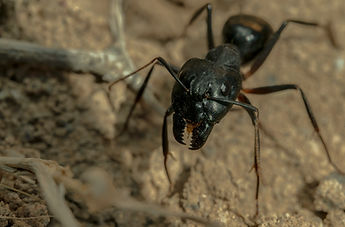
The black garden ant is one of Britain’s most common ant species.
Colonies are frequently established beneath paving, stones, walls, lawns and soil.
Biology
A colony consists of queens, workers and reproductive individuals.
Worker ants leave the nest to forage for food and communicate through chemical pheromone trails.
Once a food source has been discovered, workers can create a strong trail between the nest and the food source, explaining why large numbers of ants can suddenly appear inside buildings.
Black garden ants commonly feed on sugary substances and honeydew produced by aphids.
Pharaoh Ant
Monomorium pharaonis

The Pharaoh ant is a very small, yellowish-brown ant species particularly associated with heated buildings.
Unlike the black garden ant, Pharaoh ants can become significant indoor pests, particularly in hospitals, care facilities, hotels, flats, commercial premises and other large buildings
Biology
Pharaoh ants live in colonies containing queens, workers and developing brood.
One of their most distinctive characteristics is their ability to establish multiple interconnected colonies within a building.
They can reproduce throughout the year in warm, stable environments.
Pharaoh ants are attracted to a wide range of food sources, including sugars, proteins and fats.
Colony Behaviour
Pharaoh ants can spread through:
-
Wall cavities
-
Floor voids
-
Service ducts
-
Kitchens
-
Bathrooms
-
Heating systems
-
Electrical areas
-
Furniture
-
Other warm, concealed locations
They can reproduce through colony budding, where part of an established colony separates and establishes another colony.
This behaviour makes Pharaoh ants particularly difficult to manage and means correct identification is extremely important.
House Fly
Musca domestica

The house fly is one of Britain’s most widespread synanthropic insects, meaning it has adapted to living closely alongside humans.
It is commonly associated with food waste, refuse, animal manure and decaying organic material.
Life Cycle
House flies undergo complete metamorphosis:
Egg → Larva → Pupa → Adult
Females lay eggs in suitable organic material. Larvae, commonly known as maggots, feed and develop before pupating and eventually emerging as adult flies.
Warm conditions can significantly accelerate development.
Bluebottle
Calliphora

Bluebottles are large blow flies with a characteristic metallic blue appearance.
They are strongly associated with decaying organic matter and animal remains.
Large numbers appearing suddenly within a building can sometimes indicate a dead animal within a roof void, wall cavity, chimney or other inaccessible area.
Greenbottle
Lucilia

Greenbottles are metallic green blow flies belonging to the family Calliphoridae.
They are associated with decaying organic material and animal remains.
Their presence can therefore sometimes indicate an underlying source rather than simply being an isolated adult fly infestation.
Fleas
Ctenocephalides

Fleas are small, wingless, blood-feeding insects.
The cat flea, Ctenocephalides felis, is particularly common in domestic environments and can infest cats, dogs and properties.
Life Cycle
Fleas undergo complete metamorphosis:
Egg → Larva → Pupa → Adult
The majority of a flea population within an infested property is not present as adult fleas.
Eggs, larvae and pupae can remain hidden within carpets, bedding, furniture and cracks. This is why flea infestations can persist even when adult fleas are no longer visible.
Bed Bug
Cimex lectularius

The common bed bug is a small, wingless insect that feeds on blood.
Bed bugs are highly adapted to living close to humans and commonly hide in cracks and crevices around beds and furniture.
Biology
Bed bugs develop through several nymphal stages before reaching adulthood.
They require blood meals to develop and reproduce.
They are predominantly nocturnal and commonly emerge from harbourages when their host is resting.
Typical harbourages include:
-
Mattress seams
-
Bed frames
-
Furniture
-
Skirting boards
-
Grease marks
-
Cracks and crevices
-
Wall and floor voids
Common Clothes Moth
Tineola bisselliella

The common clothes moth is a small moth whose larvae can damage natural fibres.
The larval stage is responsible for most damage, particularly to materials containing keratin such as wool, fur and feathers.
Adult clothes moths do not cause the majority of textile damage.
Brown House Moth
Hofmannophila pseudospretella

The brown house moth is commonly encountered inside buildings.
Its larvae can feed on a variety of organic materials and debris and may occur in carpets, fabrics, stored materials and other sheltered locations.
Arachnids & Other Invertebrates
House Spider
Eratigena

House spiders are common throughout the UK and are generally harmless to humans.
They commonly construct webs in corners, sheds, garages, lofts and other sheltered areas.
Although most spiders are not considered significant pests, large numbers can become a nuisance in some properties.
Garden Spider
Araneus diadematus

The garden spider is one of Britain’s most recognisable orb-weaving spiders.
It produces the familiar circular web used to capture flying insects.
Garden spiders are generally beneficial predators and play an important role in controlling insect populations.
Silverfish
Lepisma saccharinum

Silverfish are small, wingless insects commonly associated with damp or humid environments.
They are nocturnal and feed on carbohydrates and organic materials, including starches and certain paper products.
They can be found in bathrooms, kitchens, cupboards and other areas with elevated humidity.
Woodlice
Order Isopoda

Woodlice are terrestrial crustaceans rather than insects.
They require moisture to survive and are therefore commonly found beneath stones, timber, vegetation and other damp materials.
Large numbers inside buildings can sometimes indicate excessive moisture or damp conditions.
Birds
Feral Pigeon
Columba livia domestica

The feral pigeon is descended from the rock dove and has become highly adapted to urban environments.
Buildings provide ideal artificial cliffs for nesting and roosting.
Pigeons commonly feed on seeds, grains and human food waste.
Large populations can result in substantial accumulation of droppings, nesting material and other debris.
Woodpigeon
Columba palumbus

The woodpigeon is one of Britain’s most common pigeons.
It feeds predominantly on plant material, seeds, crops, fruits and other vegetation.
Large concentrations can cause damage to agricultural crops and vegetation.
House Sparrow
Passer domesticus

House sparrows are closely associated with human habitation.
They commonly nest within cavities around buildings, roof spaces and beneath roof tiles.
They feed primarily on seeds and grains but can exploit food waste and other artificial food sources.
Starling
Sturnus vulgaris

Starlings are highly social birds and can form extremely large flocks.
They feed on insects, worms, fruit, seeds and other food sources.
Large communal roosts can create significant fouling and noise problems.
Mammals
Red Fox
Vulpes vulpes

The red fox is Britain’s only native fox species and is highly adaptable to both rural and urban environments.
Foxes are predominantly nocturnal but can be active during daylight, particularly where they have become accustomed to human activity.
Biology
Foxes are omnivorous opportunistic feeders.
Their diet can include:
-
Small mammals
-
Birds
-
Invertebrates
-
Fruit
-
Carrion
-
Food waste
-
Domestic and agricultural waste
Foxes have excellent hearing and smell and can travel considerable distances while searching for food.
Breeding
Foxes generally breed during the winter.
Following a gestation period of approximately seven to eight weeks, the female, known as a vixen, gives birth to a litter of cubs.
Cubs are generally born within an underground den, known as an earth.
The cubs remain dependent on their parents during their early development before gradually becoming independent.
Urban Foxes
Foxes have adapted exceptionally well to towns and cities.
Urban environments can provide:
-
Abundant food
-
Shelter
-
Gardens and green spaces
-
Relatively few natural predators
Fox related problems include:
-
Digging
-
Damage to lawns
-
Fouling
-
Disturbance
-
Noise
-
Denning beneath sheds and buildings
-
Scattering rubbish
-
Predation of poultry and other domestic animals
European Mole
Talpa europaea

The European mole is a specialised subterranean mammal.
Its powerful forelimbs and large claws are adapted for digging extensive underground tunnel systems.
Moles feed predominantly on earthworms and other soil invertebrates.
Biology & Behaviour
Moles are generally solitary and territorial.
They create networks of tunnels through the soil, with some tunnels used repeatedly for feeding and movement.
The familiar molehills are produced when excavated soil is pushed to the surface.
Mole activity can cause considerable damage to lawns, sports grounds, gardens and agricultural land.
European Rabbit
Oryctolagus cuniculus

The European rabbit is a herbivorous mammal that has become widespread throughout Britain.
Rabbits live in interconnected underground tunnel systems known as warrens.
Biology & Behaviour
Their diet consists predominantly of grasses, herbs and other vegetation.
Rabbits have a high reproductive potential and can produce several litters during favourable conditions.
Their feeding and burrowing behaviour can cause damage to:
-
Agricultural crops
-
Gardens
-
Grassland
-
Amenity areas
-
Embankments
-
Commercial land
Pest Identification
Correct identification is an important part of responsible pest management.
Different species can have significantly different biology, behaviour and control requirements. A treatment that may be appropriate for one species may be ineffective or inappropriate for another.
Wildlife legislation must also be considered. Some UK species are protected, and certain birds, mammals and other wildlife cannot legally be disturbed, trapped or controlled without considering the relevant legislation.
Understanding the species, its biology and the reason it is present allows pest management to be approached in a more targeted and responsible way.
Pest Scope Pest Control & Environmental Services
Professional pest management across Shropshire, the West Midlands, Herefordshire, Worcestershire and Powys.